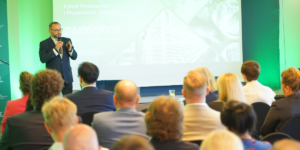



How can you build a food brand that’s recognizable far beyond your country’s borders? How can you enter global markets and grow exports, finance investments, and implement innovations that truly transform your business? Answers to these questions were revealed on June 24, 2026, during Food Agri Business Innovations Vol. 1—the Food Producers and Processors Forum at Park Hotel Diament Katowice.
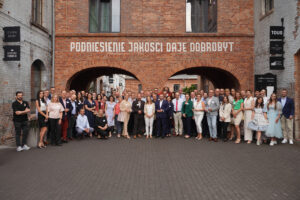
More than 120 people—including representatives of the food industry, companies offering products and services to food producers and processors, as well as experts and representatives of local governments and institutions supporting economic development—took part in the conference.
As Tomasz Zjawiony, President of the Chamber of Commerce and Industry in Katowice, emphasized, this Forum is yet another industry event dedicated to a key sector of the Polish economy, organized by the Chamber.
– The forum was established as a result of discussions held with industry representatives during our events, including the European Congress of Small and Medium-sized Enterprises. It is worth noting that this sector is one of the pillars of our economy. In 2025, exports of Polish food and agri-food products reached a record value of over 58 billion euros. We rank third in Europe in terms of a trade surplus in these goods, with poultry, dairy products, chocolate, and baked goods among the top export hits – noted the president of RIG.
As Tomasz Zjawiony added, although Polish companies are doing well competing in the European market, the food sector needs its own space to discuss expansion, innovation, sales, the promotion of Polish food, and long-term cooperation. The first edition of the Food Producers and Processors Forum provides such an opportunity.
Global taste of entrepreneurship
During a conversation with Adam Mokrysz, CEO of the Mokate Group, we learned what truly determines the success of a Polish brand on global markets. The story of the company—founded in Ustroń in 1990 and now present in 75 markets around the world—can serve as an inspiration when it comes to the direction of growth and consistency in development.
– Mokate is a relay race spanning four generations, and each one brings new values and ideas. It’s worth investing surplus funds and developing local structures in other countries. I’ve learned that exporting is a bumpy road—a one-time trade show appearance or B2B meeting isn’t enough. I always emphasize that business is about people, not companies. In the end, someone has to talk to someone else, build trust, identify shared interests and values, and take that first concrete step.
Does Polish food face more opportunities or more barriers in global markets today?” wondered the participants of the panel discussion titled “Foreign Expansion and Expansion Through Retail Chains – Opportunities, Threats, Barriers, and Support.”
According to Michał Grela, the Management Board’s Representative for the Implementation of the Strategy of Krajowa Grupa Spożywcza S.A., Krajowa Grupa Spożywcza S.A. is facing a transformation resulting from its expansion into new global markets, as well as challenges related to sustainable development and CO2 emissions, and, ultimately, a focus on consumer safety and health.
Ireneusz Ozga of VICI Polska discussed the range of Polish food products and their unique characteristics, noting that successful exports depend on more than just the product and a good price.
– We have a surplus of milk and dairy products in Poland. We don’t know what to do with them, so we’re selling them below cost. Meanwhile, Polish rapeseed processing plants have to import oil. We have plenty of food, but no single export market. The ratio of convenience foods to processed foods is too high.
Tomasz Tetla, Managing Director Europe of DT Strategy pointed out potential pitfalls in export expansion.
– You have to be a predictable, reliable business partner. You need to have the necessary production and investment capabilities to meet the growing needs of, for example, supermarket chains. The strategy must be tailored to local requirements and structures. We need to have a plan for the role the product will play in a given category and for the category’s development.
Polish food has enormous potential, but global expansion requires a strategy, an understanding of local conditions, and a willingness to adapt. Of the 1.2 million farms in Poland, only slightly more than 200,000 are run by true entrepreneurs, and what matters most is a company’s ability to adapt to very different markets.
Poland tastes good
The year-over-year growth in exports of Polish food products is encouraging… But can Polish food become a global brand on par with Italian or French brands? The panel discussion “Made in Poland – Promoting Polish Food on the Domestic and International Markets” showed that we have enormous potential: quality, safety, consistency, and the increasingly compelling stories of family-owned businesses.
– Does the “Polish” brand give us an advantage? Absolutely. We can be confident in the safety of the product. This is thanks to what Polish food companies have achieved over the past 2–3 decades. Top quality, consistency, and product safety. There are many companies that can compete on global markets; they’re unique. But is the general public aware of them?—asked Michał Lipiński, Director of the “Teraz Polska” Competition.
In global markets, quality alone is no longer enough. What’s needed is brand recognition, consistent promotion, and the ability to demonstrate that “Polish” means modern, authentic, and trustworthy.
– This is happening, but promoting food on a global scale isn’t a sprint—it’s a marathon. We must remember that the Italians and the French started decades ago, while we began a dozen or so years ago, burdened by political issues and stereotypes about “inferior” Eastern Europe,” – emphasized Joanna Pietrzak, Deputy Director of the Export Support Department at the National Center for Agricultural Support.
Paweł Maciążek, the creator of the Food Farmer mobile app, which connects consumers directly with local farmers, producers, and artisans, highlighted the strength of regionalism and traditional Polish agriculture.
– Right now, we have 13,000 food suppliers who want to sell directly. The problem lies in rising production costs, an unpredictable climate, and, of course, price pressure from large buyers. Interestingly, while we don’t yet have the ability to sell abroad, we already have several thousand potential German customers interested in Food Farmer – commented Paweł Maciążek.
Marcin Oszańca, Director of the Agricultural Advisory Center in Brwinów, highlighted the need for information on where to buy good food:
– We’ve made incredible progress: when we joined the European Union, our exports totaled 5 billion euros; now they’re 10 times that amount. It’s not just economies of scale that allow us to compete. We have the wine industry, cheese-making, and the agritourism sector is growing. This is a huge opportunity for smaller producers to make a name for themselves. There are trends toward local trade, direct sales, and vending machines. We want to pursue innovations that are convenient for consumers.
The panelists summed it up: “Poland tastes good”—but the world needs to know more often where and why it’s worth seeking out that flavor.
Innovations in language
Every year, several thousand new food products appear on store shelves. Some of them are the result of manufacturers’ marketing efforts, but there are also genuine innovations among them. Participants in the panel discussion “Innovations in the Food Market in Poland and Europe” used their own experiences to illustrate the difficult path to ultimately reaching consumers’ shopping carts. This involves new processes, business models, collaboration with the scientific community, automation, and the ability to move from concept to commercialization.
Nadia Paterek, the founder and owner of the “Souffle des champs” brand—a corn-based fermented beverage—emphasized the market’s focus on food-tech trends and foods that support the body and promote health.
Dorian Zisenbach of Grzybomoc Sp. z o.o. spoke about bureaucratic problems, barriers encountered at government offices regarding the nature of this new product (medicinal mushrooms), and the challenges involved in developing this emerging industry in Poland.
– Innovation in the food sector is not as widespread as in other industries; there is less need for research. It is important not to downplay the significance of innovation. Even small changes are valuable in companies – said Jakub Jasiczak, Chairman of the Association of Special Purpose Companies.
It’s important to make farmers and food producers aware that innovation doesn’t have to be a revolution. Sometimes it starts with a small change that truly meets the needs of the market and consumers.
The discussions during the Forum were supported by research findings, reports, specific innovations in production, and—importantly—methods of financing them, as presented by the invited experts.
Tomasz Zjawin, CEO of IBN Engineering Sp. z o.o. and co-founder of OVUMA incubation, demonstrated how process automation and control algorithms work, using modern duck incubators as an example.
Dariusz Lipka, President of BLDG Dotacje Sp. z o.o., noted that it has been a long time since there was such a bountiful year in terms of EU and national grants for the food production and processing sector. The scope of funding includes: new technologies, research and development, processing and wholesale trade in agricultural products, promotion of innovative brands, as well as a new area—dual-use technologies—that involve food safety aspects..
Jakub Jakubczak, Food & Agri Sector Manager in the Industry Expertise Department at BNP Paribas, presented the report “Where Is the Food Market Headed? 12 Trends for 12 Months.” Food can be viewed as a mirror of cultural, technological, and social changes. The expert discussed the role of social media in driving trends and fashions. Increasingly personalized products are appearing on the market, including alternatives to traditional sweets and snacks. Advanced AI analytics are being used to map out the entire consumer and product journey.
The Forum’s program also featured presentations on the latest innovations from Polish science. Prof. Janusz Kapuśniak, Ph.D., from Jan Długosz University in Częstochowa explained how, in collaboration with industry, product innovations are being developed in the fields of natural polymers and functional foods—such as the concept of vegan coffee creamers without artificial additives.
The event’s rich program, along with the interest in the gathering and the opportunity to network with business decision-makers who implement solutions and understand the industry’s challenges from firsthand experience, demonstrated just how great the need is for knowledge sharing and building business relationships.
We invite Forum participants who wish to promote Polish food, expand their businesses, and seek inspiration from industry professionals to attend the 16th European SME Congress on October 27–28 in Katowice, where the topics discussed at the Food Producers and Processors Forum will be further explored.

Latest
-
Silesia on grass
-
The strength of Metropolis GZM lies in the cooperation among local governments while preserving their autonomy
-
The Ecol Group acquires Ad Moto and strengthens its position in the industrial oil services sector
-
Food Agri Business Innovations is now behind us: polish food sector, export and innovations
-
Business with a Touch of Fairy Tale – A Closed Networking Event for RIG Member Companies in Katowice